Bored With Your Clothes? Here’s Why It Happens and How to Fix It.
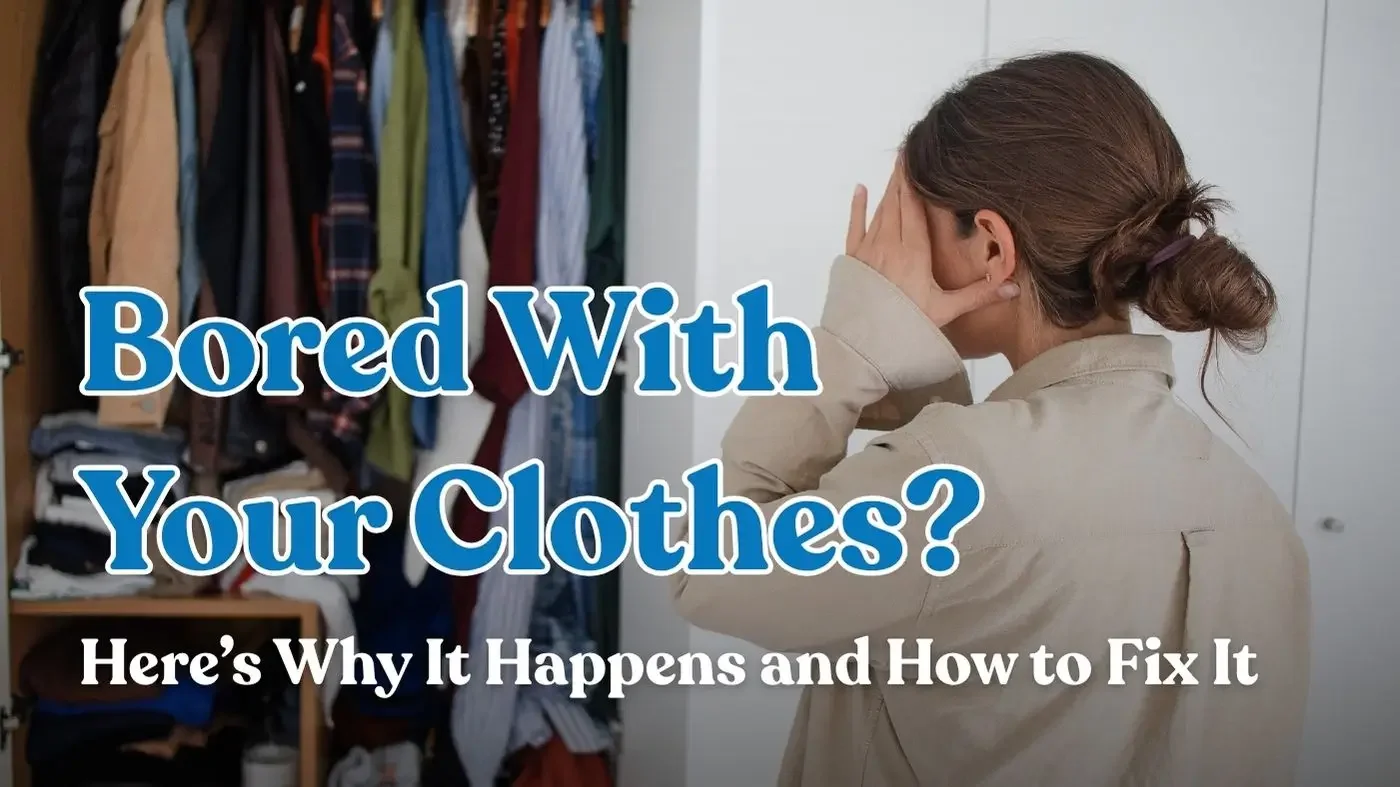
When every outfit suddenly feels “wrong,” the real issue isn’t your clothes. It’s why the boredom showed up.
Why your wardrobe feels boring even with plenty inside
Your brain adapts to repetition quickly. When you reach for the same combinations each week, even great clothes lose their spark. This is psychological, not stylistic.
A cluttered or unclear closet also dulls your perception. Visual noise makes everything feel older than it is. Boredom grows when the wardrobe stops feeling like a system and starts feeling like a pile.
If you want to reset your wardrobe visually and mentally, try the free Wardrobe Detox checklist. It’s a gentle way to start fresh.
The real reason everything in your closet feels “meh”
Wardrobe boredom is often a delayed reaction to a sense of life feeling repetitive. When your days blur together, your outfits do too. Your clothes don’t feel exciting because your routine doesn’t feel exciting.
This is why even a well-curated wardrobe can feel flat: the boredom isn’t always coming from the closet. Sometimes, it’s coming from life.
How social media overstimulates your style decisions.
Why social media infused comparison makes your clothes look worse
Social media accelerates wardrobe boredom by exposing you to endless outfit novelty. Your eyes get used to stimulation at a pace no real wardrobe can match.
Algorithms repeat the same trending items until they feel “essential.” You start believing something is missing. And not because your clothes are wrong, but because repetition manufactured desire.
It’s engineered boredom.
Why does buying something new feel so great
Buying something new feels like relief because novelty triggers dopamine. For a moment, the boredom disappears, and everything seems possible again.
But clothing hauls don’t fix the underlying issue. They add volume to the same confused system. Without clarity, even new pieces fade into the background quickly.
Shopping feels like a fix because fantasy is easier than facing wardrobe overwhelm.
If impulse shopping has been a pattern, Ep. 1 of the Style Shifter Podcast: Break Free From Impulse Shopping goes deeper into why the urge feels so strong and what to do about it.
Does shopping actually help when you’re bored with your clothes?
Hauls help for a few hours, sometimes minutes. The thrill evaporates once novelty wears off. You return to the same decision fatigue you had before, now with more items to manage.
Shopping can’t fix a structural problem. It can only distract you from it.
Wardrobe boredom fades through clarity and curiosity, not consumption.
Popularised quick fixes that never actually fix wardrobe boredom
Copying influencer outfits rarely works because their clothes come with their lifestyle, professional lighting, and often skinny proportions.
Thrifting for “something fun” adds novelty but usually disrupts cohesion. Random pieces increase confusion, not creativity.
New makeup, jewellery, or accessories create tiny sparks of interest. But if the core wardrobe feels stale, those sparks disappear quickly.
Emotional triggers behind wardrobe boredom
Wardrobe boredom often shows up when emotions are messy. Anxiety makes you doubt everything in your closet. Loneliness pushes you toward novelty for entertainment. Fatigue makes creativity feel impossible.
None of this means your wardrobe is bad.
It means your emotional capacity is lower, and clothing is where it leaks out.
What anxiety does to your sense of style
Anxiety makes your wardrobe feel wrong because nothing provides the certainty you’re seeking. Buying something new feels like taking control.
But anxiety also shrinks your decision-making bandwidth. Outfits feel “off” because your mind is overwhelmed, not because your clothes are lacking.
Your style didn’t disappear; your mental energy did.

When every outfit starts to feel the same.
Is this boredom or a full style rut?
A style rut is habitual: you keep choosing the same combinations. Wardrobe boredom is emotional: the clothes feel lifeless even if they’re good.
A rut can be fixed with styling experiments. Boredom requires reconnection: rediscovering who you are today and how your clothes support that.
They’re related, but not the same.
What questions to ask yourself before buying something new
These questions reveal whether you’re bored or simply seeking escape:
Am I craving excitement or clarity?
Do I want this item or the fantasy around it?
Does this purchase solve a real wardrobe gap?
Would I still want it without the algorithm reminding me it exists?
Your answers indicate whether you need to purchase or pause.
How mindful shopping differs from impulse buying
Mindful shopping happens when a specific wardrobe need is clear. The item fits your lifestyle, palette, silhouettes, and existing combinations.
Impulse buying happens when you’re chasing a feeling: excitement, distraction, validation. Those pieces rarely integrate well because they were chosen for emotion rather than for your wardrobe.
Mindful shopping stabilises your style. Impulse shopping destabilises it.
How to make your current clothes feel interesting again
You can shift wardrobe boredom by reconnecting with your clothes through low-pressure exploration. Touching fabrics, noticing textures, and rediscovering forgotten details bring back the sense of abundance.
Trying new colour pairings or unusual layering combinations creates visual novelty. Curiosity replaces the urge to shop.
Creativity, not consumption, creates excitement.
How organising your closet changes everything
Visual clarity reduces boredom instantly. When clothes are steamed, colour-grouped, or folded intentionally, your wardrobe feels new to your eyes.
Order creates excitement because your brain reads “refresh,” not “repetition.” You haven’t changed the items; you’ve changed the environment.
A clear system makes creativity easier and boredom weaker.
A capsule wardrobe built around your colours, body, and style eliminates the 'nothing to wear' feeling — because every piece was chosen to work together.
Why browsing shops makes everything in your closet look worse
When you’re bored, your brain is primed for novelty. Browsing shops, even “just to look”, feeds the fantasy that something out there will fix the feeling.
Algorithms see that you’re browsing and push more temptation your way. Meanwhile, the clothes you already own lose emotional value simply because they’re familiar.
Avoiding browsing protects your clarity, style and wallet.
Why you start wanting things you keep seeing online
The Familiarity Effect convinces your brain that repeated items are desirable. You don’t want them because they’re good; you want them because you’ve seen them twenty times today.
This is algorithmic conditioning, not personal taste.
Understanding this breaks the spell almost instantly.
If you want the social-media experience without being chased by ads, algorithms, or influencers who apparently shop for a living, the Wonder Wardrobe community is where we talk about these tactics like actual adults and stop letting them mess with our wardrobes.
Does buying better quality clothes really make a difference?
Quality pieces stay interesting longer because they have depth: richer fabric, better construction, more flattering movement. Your eye enjoys them every time.
Quality also reduces boredom by making repetition feel intentional. A beautiful sweater worn often feels like a signature, not a fallback.
Quality has staying power. Trends don’t.
New combinations often hide in pieces you already own.
How to create new outfits without buying anything new
Start with colours. Identify which colours make you look and feel beautiful. Then build new pairings using those first. When colour shifts, the whole outfit feels new.
Try small experiments: different proportions, a new tuck, unexpected layering. These micro-adjustments create novelty without adding anything to your wardrobe.
Play is the fastest route out of boredom.
Would swapping clothes with a friend break the boredom cycle?
Swapping introduces novelty without adding clutter. Seeing a friend love your item reframes its value. Borrowing theirs gives you a temporary refresh without the commitment of ownership.
It’s playful, social, and generous: three things algorithms can’t replicate.
Can gratitude actually change how you feel about your clothes?
A small gratitude practice shifts your attention from what’s missing to what’s already working. Over time, your brain learns to recognize abundance instead of lack.
This reduces impulse shopping dramatically. Gratitude softens the urgency and makes your wardrobe feel richer.
It’s simply a psychological recalibration.
When shopping does help and when it doesn’t
Shopping helps only after clarity returns. A purchase is helpful when it directly expands your outfit options, fits your palette, and serves your real lifestyle.
Shopping hurts when it fills emotional gaps or distracts from boredom.
The difference is intention.
When you feel grounded and curious, new pieces integrate easily. When you feel restless, they usually don’t.
How to stop this boredom cycle from coming back
Long-term relief comes from structure, not more clothes. A fully interchangeable wardrobe creates endless combinations and reduces decision fatigue.
Aligning your colours, silhouettes, lifestyle needs, and outfit formulas keeps your wardrobe evolving with you. When your wardrobe fits your life, boredom can’t find much space.
Consistency replaces the cycle of craving and disappointment.
Final Note
Boredom is a useful signal. It points to gaps: in clarity, in colour, in your style choices, or in your emotional bandwidth.
Once you understand the source, the solutions become apparent.
So which type of boredom is it for you: emotional, style-related, or algorithm-induced?